


The Mad Trapper Profile
Some of the Behavioral Analysis was straight-forward common sense like being an outdoorsman and a builder. But I really went out on a limb with my Aviation profile.
This was very early in the Age of Flight, only 14 or 15 years after Orville and Wilbur Wright and Kittyhawk. But I had confidence even then about the Aviation indicator. Only a year earlier, a survey of serial killer professions had listed Aircraft Mechanic and Assembler as the number 1 skilled job of serial killers. So it wasn’t that big a leap. So the Profile was largely correct if we're talking about Ben Larson.
However, I did lean toward him being an Incel and someone who was an outlaw or was living an outlaw lifestyle in his mind. But I didn't commit to those theories.
Fortunately I didn't because they were both wrong. He was with Tillie Larson for 9 years before disappearing and she had five kids. He was not an outlaw in any shape or form. Constable William Carter was right—Ben Larson was "a cornered animal" and acted like one.
Almost everything else, we got right. I would also include participation in the war, which I also leaned toward but did not commit to. He was in the Balloon Companies in WWI. The only thing that we got wrong was that his father was always there and appeared to be a solid father figure and a hard-working farmer and family man. That would explain his not being in the criminal classes or an outlaw in any way.
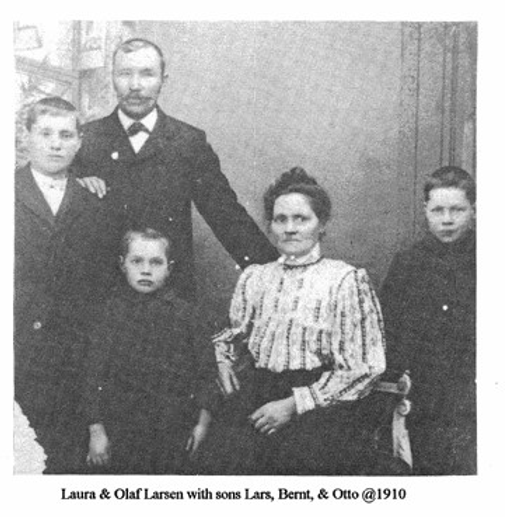
Here is a family photo with Ben, his parents and his brothers. Ben is the middle child on the right. Otto, the youngest, also went to Canada and disappeared in the 20s.


Bennie and the Profile
Ben Larson's Profile
Ben Larson
in the North Dakota Military Men, 1917-1918
Name: Ben Larson
Birth Date: 17 May 1898
Military Date: 25 Jan 1918
[Age 17]
Military Place: Minneapolis, Minn
Army Number: 1,335,100
Enlistment Type: Enlisted
Registrant: no, under age [age 17]
Parents Origin: naturalized citizen
Occupation: Farmer
Comments: enlisted at Minneapolis, Minn., on Jan. 25, 1918; sent to Jefferson Barracks, Mo.; served in Aviation Mobilization Depot, Camp Sevier, S. C., to March 21, 1918; Company A, 2nd Balloon Squadron, to March 22, 1919; 1st Balloon Company, to discharge; overseas from March 29, 1918, to June 5, 1919. Engagements: Defensive: Champagne-Marne. Offensives: Aisne-Marne; St. Mihiel; Meuse-Argonne. Defensive Sectors: Lorraine: Champagne; Ile-de-France. Discharged at Camp Dodge, Iowa, on June 19, 1919, as a Private.

An American balloon observer prepares to ascend in a captive balloon for a reconnaissance mission. Photograph from the U.S. Air Service in World War I: Volume 1.
“From September 26 to November 11 we lived under the most trying conditions without any relief. Weeks passed when we were working and sleeping in mud six inches deep. During those trying days it was seldom that we were dry. Two French balloon companies and one American company were put out of action of account of sickness, but we managed, probably through luck, to stick it out.”
— Excerpt from the History of the Second Balloon Company, The Balloon Section of the American Expeditionary Forces
The Carter Report
What I am about to tell you is the true story of the manhunt for the Mad Trapper of Rat River. From the confidential Carter Report.
Constable William Carter writes:
The interrogation of Johnson by Millen at McPherson
From witnesses accounts of Contable Millen's interviewing Johnson, they stated that Constable Millen was lax in soliciting information from Johnson of his intentions, his probable location of camp, of trapping in the country and other useful information necessary for the police to have on a stranger to the Territories… The witnesses also added that as Johnson paid in cash for all goods purchased, the fact influenced Constable Millen's questioning of Johnson.
The shooting of King - from Constable King and McDowell
King and Special Constable Bernard advanced to the cabin with their dog teams. Constable McDowell and Special Constable from Aklavik Lazarus Sittichiulis remained hidden behind the river bank; covering the cabin was Constable McDowell, with a rifle. King knocked at the door of the cabin several times but there was no answer. Johnson was inside, as he looked through the window opening. King explained his visit but Johnson ducked back and did not say a word. King was just going to knock again when a bullet came through the door, and King fell to the ground.
Dynamiting Johnson's Cabin - Inspector Eames' own words to me
When the posse arrived on the site, the dynamiting commenced later by throwing sticks of dynamite at the cabin, which had no effect. An attempt was made to drop a stick of dynamite down the chimney pipe; this had no effect; did not explode, or maybe Johnson defused the dynamite. As reported a bundle of sticks of dynamite was thrown at the cabin, and this also had no effect. According to Inspector Eames, 'the dynamite did practically no damage to the cabin, and it wasn't until after Johnson had escaped was the cabin destroyed by manual labour, so that Johnson could not return and again use it as a so-called fort.
Nature deteriorated the power of the dynamite before it could be useful and all of it was of no effect. The dynamite which was obtained from Blake, had been stolen from the Northern Mining Exploration cache.
Sometime during the night Johnson escaped and it wasn't found out until the posse returned the next day for another attempt at dislodging Johnson, so further patrols had to be set up to locate the man
The cairn commemorating RCMP Constable Millen , shot by Johnson on January 30, 1931, located on Millen Creek near the site of the second shootout where Millen was killed.
The shooting of Millen - from Riddell and Verville
A patrol of four men were sent out to scour the countryside for Johnson. They found him camped against the riverbank, fairly well up in some light bush, where fire-wood was handy. A small tarp was erected which faced towards the river, and when the four men, Millen, Verville, Riddell and Gardlund came up they heard Johnson whistling, singing and cutting wood. They debated what to do and with the decision started firing at the tarp. Altogether they fired about 200 rounds of ammunition (a good example of why there was a constant shortage of ammunition throughout the manhunt). They could hear the bullets striking Johnson's pots and pans or cooking utensils, or whatever he had. (None of these items were turned in.) Millen and Riddell were together advancing head-on when a shot rang out, and in Riddell's own words, just missed him. He ducked down behind a bank and when he looked up he saw Millen pointing his gun off to his left at about 11 o'clock and fired a shot. Then Johnson retaliated and Millen dropped to the ground.
The 12th of February we were at LaPierre House. There were discussions about what would be done if Johnson was met with and, although no orders were given, I'm certain the men were in accord to shoot first and ask questions later.
We knew that Johnson was not far away as "Wop" had spotted the well-known snowshoe trail on the Eagle River. So it happened that those that were up in the lead commenced firing and Johnson turned to run back the way he had come. As of yet, he had not donned his snowshoes.
It was not known at the time that Johnson carried a box of .22 ammunition in his hip pocket. It was determined later that someone had hit the ammunition with a 270-300 bullet making quite a mess of the hip (Johnson had turned and was running away). Johnson donned his snow-shoes and made for the bank of the river, presumably to get into some bush where he could better defend himself. At this point, Hersey ran over to the opposite bank where he could get a better shot. (Johnson's body was seen to jerk when he was hit on the .22 ammunition.) Johnson could not make it up the bank due to the shattered hip and returned to the centre of the river. At this point he must have been a dying MAN because he bled profusely.
Taking his rifle off his shoulder, he pulled it out of the scabbard; uncorked the muzzle, the cork being tied to the rifle with a string, brought the rifle to his shoulder and fired at Hersey, who was kneeling down, and the bullet struck Hersey's elbow, that was resting on his knee; passed through one lung, collapsing it entirely, nicked the heart and nicked the other lung. Johnson was pinned down by the rifle fire or was unable to move and, as I said before, a dying MAN. He had taken off his snowshoes and laid them on the snow; having placed his bedroll in front of him, he was lying down on the shoes prepared to fight it out.
Inspector Eames called out three times for Johnson to surrender but Johnson just waved his hand and finally Eame's section commenced firing which was taken up by the party on Johnson's left.
"War plus 20 years equals Serial Killer."
Peter Vronsky in his book Sons of Cain: A History of Serial Killers from the Stone Age to the Present
Serial Killer or "Cornered Animal*"
*QUOTE/ Constable William Carter, The Carter Report